![[TheQoo] “Why do we pay for V’s advertising fees?”... Low-price coffee industry’s billion-dollar star marketing competition ‘light and dark’](https://lh3.googleusercontent.com/blogger_img_proxy/AEn0k_uQZpw6eUNwU0zaE-6LI89QKtL5NmTM-MUvuv50w3CbLX8CE1oddygrQljaf_W6oZYnU9TbzjMKVsJGxSshfZRHt16yVUuEUmXKSwsAKB9k8BRPkbIpD5b0kTe-iNpIXnqdQ-mEaIa3ChkZ05PIZVEPK3xtbVw=w1200)
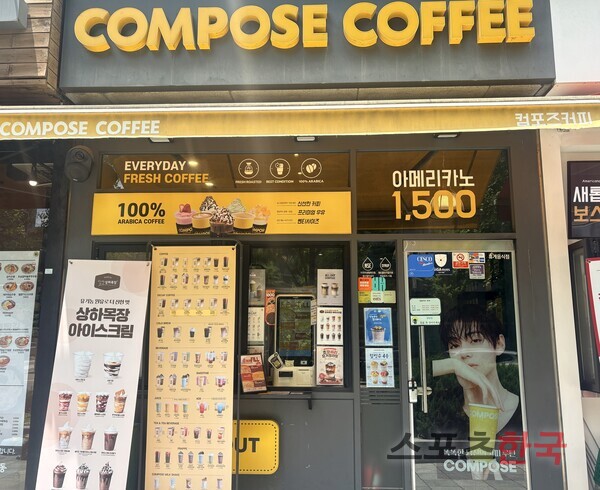
[Sports Korea Reporter Kim Na-yeon] As star marketing competition in the low-priced coffee franchise industry becomes more heated, side effects are also increasing. Recently, as Compose Coffee is seeking to renew its contract with BTS member V as an advertising model, conflict is growing over a plan to have franchisees share some of the advertising costs. In the industry, it is analyzed that this controversy is not simply a conflict over advertising costs for a specific brand, but is leading to a 'super luxury model competition' that has spread throughout the low-priced coffee market and a controversy over the effectiveness and bubble of advertising costs worth billions of won.
According to the franchise industry on the 26th, Compose Coffee recently sent a motion to execute advertising expenses, including V's contract renewal, to franchise owners nationwide and is in the process of voting for or against it. Under the current Franchise Business Act, a franchisor can run advertisements and share some of the costs with franchisees if it obtains the consent of a majority of franchisees.
According to the agreement, the contract period is one year from next month to June of next year. The total advertising cost was reported to be 7.35 billion won. Among these, brand marketing costs using V amounted to KRW 5.4 billion, and marketing costs for other models and influencers amounted to KRW 1.95 billion.
The cost is borne 60% by the head office and 40% by franchise owners. Accordingly, the headquarters will bear approximately 4.41 billion won, and store owners will share a total of 2.94 billion won. The cost per store is known to be around 80,000 won per month (excluding VAT).
When Compose Coffee first hired V as a brand model in 2024, franchise owners paid about 2 billion won out of a total advertising cost of 6 billion won. It was reported that in the advertising contract carried out last year, an advertising fee of approximately 90,000 won per month was charged per store. As this contract renewal was also promoted in the same manner, opposition from some store owners surfaced again.
Accordingly, Compose Coffee said, “We operate advertising and marketing activities transparently to increase franchise sales and strengthen brand competitiveness,” and added, “60% of total advertising costs are borne by the headquarters, which is a high level in the industry.”
He went on to explain, “Advertising costs include not only specific model fees, but also overall costs such as advertising production and brand marketing,” and added, “We have reduced the overall advertising cost through efficiency in advertising operations, and the store owner’s average monthly advertising cost burden has also been lowered by about 11.3% compared to the previous year.”
However, the reason franchise owners are raising issues is not simply because of the amount of 80,000 won per month. Store owners complain that store operating costs are continuously increasing due to the recent increase in the price of raw materials such as coffee beans, milk, and cups, as well as the minimum wage increase and the burden of rent. The position is that the additional fixed costs incurred here are a great burden.
There are many questions surrounding the effectiveness of advertising. In particular, controversy grew as the perceived effect could vary greatly depending on the commercial district. It is argued that global star models such as BTS can help increase brand awareness in downtown commercial areas with a large influx of foreign tourists and young consumers, but it is difficult to feel the advertising effect in residential areas with a high proportion of regular customers, office commercial districts with a high concentration of office workers, and rural areas.
One store owner, who requested anonymity, said, “80,000 won per month is an amount that cannot be taken lightly in a low-priced coffee store,” and added, “From the store owner’s perspective, who cannot feel the effects of advertising, it is bound to feel like another cost burden.”
He continued, “There is not enough objective data disclosed about how much actual sales increased after using V as an advertising model,” and emphasized, “If store owners have to share costs, at least specific explanations and data on the effect of actual sales increase compared to advertising investment are needed.”
Inside and outside the franchise industry, it is pointed out that this controversy is not just Compose Coffee's problem. In fact, recently, the low-priced coffee industry is virtually engaged in a ‘star model war.’ Star marketing has become so common that it is difficult to find a low-price coffee brand that has not used a global star as its brand model.
Mega MGC Coffee is using national soccer player Son Heung-min as its model, The Venti is using singer G-Dragon, and Mammoth Coffee is using actor Kim Woo-bin as its model. Ediya Coffee also joined the star marketing race last year by selecting actor Byun Woo-seok as its brand model for the first time since its founding.
Analysis suggests that the reason the industry hires famous stars, even at the cost of modeling fees amounting to billions of won, is a market environment that has reached a point of saturation.
According to the franchise industry, the number of stores of five major domestic low-priced coffee franchises (Mega MGC Coffee, Compose Coffee, Mammoth Coffee, Paekdabang, and The Venti) has increased from about 3,000 in 2020 to over 10,000 as of six years later.
As the number of stores has rapidly increased, it has become difficult to differentiate through price and menu competition alone. Accordingly, marketing using brand image and fandom has emerged as a new means of competition. In particular, stars with a strong global fandom, such as BTS' V or G-Dragon, are highly preferred by companies because they can imprint their brands not only on domestic consumers but also on overseas consumers.
Compose Coffee has continued aggressive marketing since being acquired by the Philippine restaurant company Jollibee Foods and the private equity fund Elevation PE consortium for approximately 470 billion won in 2024. Last year's sales were 300.3 billion won, a significant increase compared to the previous year, but operating profit was approximately 39.8 billion won, which was similar to the previous year. The industry believes that aggressive investment costs, including advertising costs, may have affected profitability.
Conflicts over advertising fees for famous stars have existed before. Mega MGC Coffee had a conflict with store owners over the sharing of advertising costs when it hired Son Heung-min as its model in 2022. However, in addition to using advertising models, Mega Coffee continued to engage in various marketing activities, including TV and digital advertisements, holding large-scale concerts by popular idol groups, collaborating with famous characters, and drama PPL. This marketing strategy of the headquarters is evaluated to have led to an actual increase in sales.
Mega Coffee expanded the number of stores from about 2,156 in 2022 to more than 3,600 last year, and operator N House's sales last year were about 496 billion won, a 35% increase compared to the previous year. In a survey conducted at the end of 2024 ahead of the execution of advertising costs in 2025, it was reported that 97.1% of franchise owners agreed to share advertising costs with the head office 50:50. This is an example that shows that if the advertising effect of the head office's marketing leads to actual sales growth, store owners' acceptance can increase.
On the other hand, Ediya Coffee minimized noise surrounding advertising cost sharing by choosing to have the headquarters cover the entire cost of hiring Byun Woo-seok's model. The Venty shares model fees with franchisees, but the headquarters is said to have borne additional marketing costs due to using models, including production costs for advertisements and promotional materials and media execution costs. Even for the same star marketing, store owners’ reactions can vary greatly depending on the cost burden structure.
However, some say that such star marketing is a double-edged sword. This is because if a brand model causes privacy controversy or social controversy, it can have a fatal impact not only on advertising effectiveness but also on the brand image. In the end, advertising model risk is a burden that the brand must bear.
An official in the low-price coffee industry said, “Generally, famous stars are hired in the hope of increasing brand awareness in a short period of time, but we must also consider the fact that individual models’ issues can lead to brand risks,” adding, “Risk management has become as important an element of star marketing as the effectiveness of advertising.”
Ultimately, industry insiders agree that the success or failure of star marketing in the low-priced coffee industry depends not on the celebrity of the model but on ‘the performance perceived by the store owner.’ It is pointed out that beyond simply using famous celebrities as models to gain attention, there is a growing demand for verification of whether advertising costs worth billions of won lead to actual consumption.
An official in the franchise industry said, “Low-priced coffee is a market where consumers decide to purchase based on accessibility, price, and daily usage habits rather than looking at the brand model.” He added, “In particular, office workers often habitually visit stores they always use on their way to work or during lunch hours.”
He continued, “The reason the headquarters uses star models is to ultimately increase franchise sales and raise brand value. If the effectiveness of advertising is confirmed to result in increased sales, store owners may be willing to accept it, but if there is no perceived effect, even small costs are bound to become a sensitive source of conflict.”
https://sports.hankooki.com/news/articleView.html?idxno=6935501